
Share this on:
In This Article
Turn your television into a sophisticated part of your home’s interior
Televisions are one of the most used objects in modern homes, yet they are rarely designed with beauty in mind. A large black screen mounted on a wall often becomes a visual interruption rather than a thoughtful part of the room. Interior designers frequently struggle with this problem because a television can disrupt the balance of an otherwise carefully designed space.
This is where TV frame design changes everything.
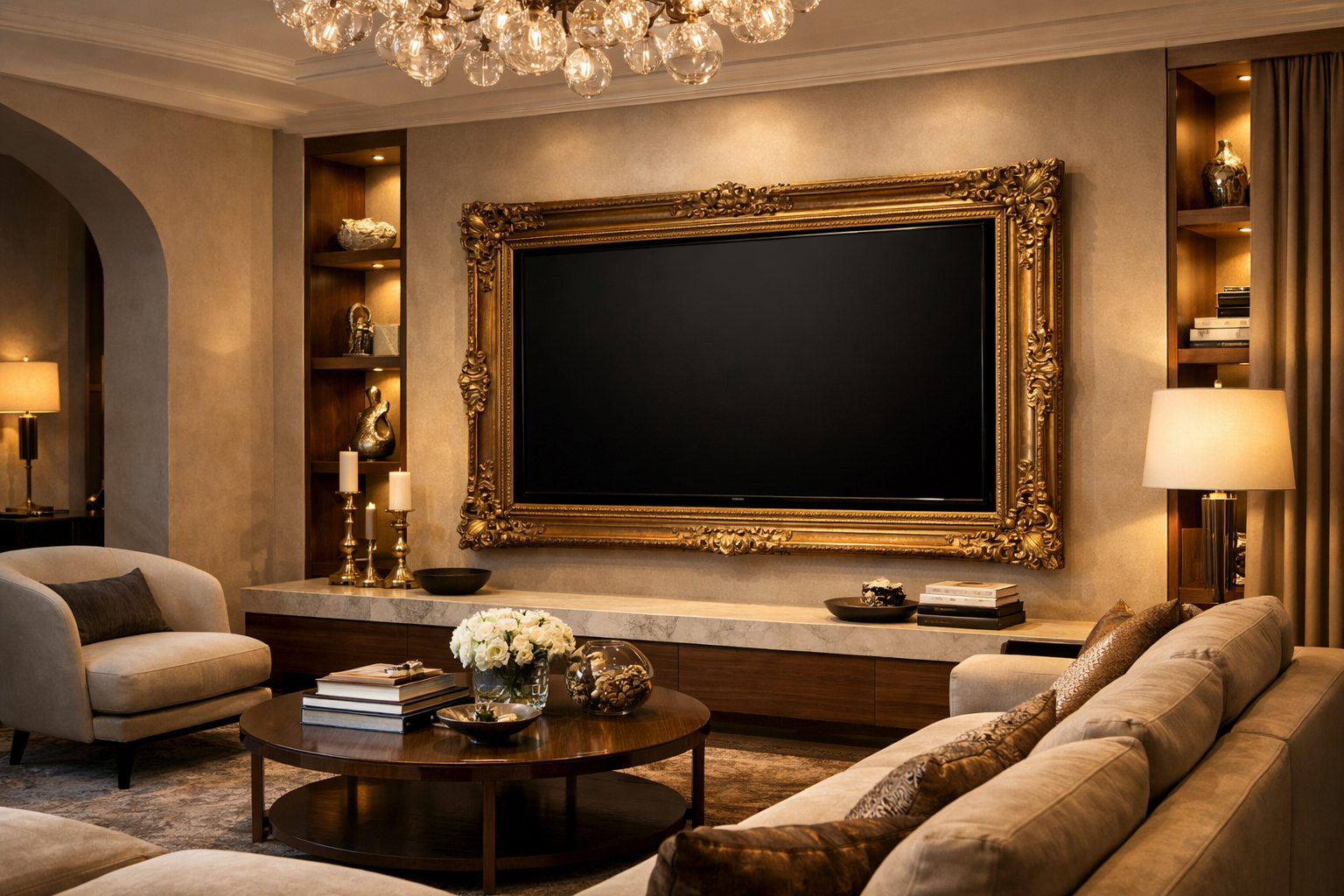
Framing a television transforms it from a purely functional device into an intentional design element that complements the room instead of competing with it. What once looked like a blank screen can become a centerpiece that blends seamlessly with your decor.
In this guide, you will discover seven powerful ways TV frame design can turn your television into a sophisticated part of your home’s interior.
Why TVs Often Disrupt Interior Design
Before discussing solutions, it helps to understand the design problem televisions create.
Traditional televisions are built for performance rather than aesthetics. Most feature glossy black surfaces, minimal styling, and a shape that contrasts with surrounding furniture and artwork.
This creates several design issues.
The black screen effect – When a TV is off, it appears as a large black rectangle. In rooms with warm textures, art, wood, and color, this dark surface draws unwanted attention.
Competing focal points – Many living rooms are designed around focal points such as fireplaces, artwork, or windows. A large television often competes with these features and disrupts visual balance.
Minimal integration with decor – Unlike framed artwork or furniture, televisions rarely complement the style of a room. Whether your home is modern, traditional, rustic, or eclectic, a bare TV rarely fits naturally.
Interior designers have long searched for ways to hide televisions or make them less noticeable. TV frame design offers a much better solution.
What Is TV Frame Design
TV frame design is the process of surrounding a television with a decorative frame so it visually resembles artwork or an intentional architectural element.
Instead of appearing like a piece of technology, the television blends into the design language of the room.
This concept is not new. Museums, galleries, and interior designers have framed displays for decades. The difference today is that custom frame solutions make it easy for homeowners to achieve the same effect.
Companies like TV Framez design frames specifically engineered to fit modern televisions securely while complementing interior decor.
The result is a television that feels like it belongs in the room.
Here are 7 Powerful Ways to Transform Your TV Into a Design Feature
1. Turn the TV Into a Focal Point Instead of a Distraction
One of the biggest advantages of TV frame design is the ability to transform a distraction into a focal point.
Rather than trying to hide the television, framing it elevates its presence.
When surrounded by a thoughtfully designed frame, the TV appears similar to a large piece of wall art. This helps it blend naturally with other framed artwork, mirrors, or photographs in the space.
Interior designers often use this technique in gallery walls where a framed television can sit among paintings and prints without standing out as a piece of technology.
Instead of dominating the room with a blank screen, the framed television contributes to the overall visual story.
2. Create Harmony With Your Interior Style
Homes come in many styles, from contemporary lofts to classic traditional spaces. A bare television rarely complements these aesthetics.
TV frame design allows homeowners to match the style of the room. For example:
Modern interiors – Minimalist metal or slim matte frames maintain a clean aesthetic.
Traditional interiors – Ornate or wood inspired frames mimic classic artwork frames.
Rustic or farmhouse spaces – Textured or wood toned frames add warmth that matches natural materials.
Luxury interiors – Gold, brushed metal, or high gloss finishes create a gallery like appearance.
Instead of feeling like a technology upgrade that clashes with the room, the television becomes a natural extension of the design.
3. Improve Visual Balance in the Room
Good interior design relies heavily on visual balance. Large blank surfaces can disrupt that balance. Framing a television adds proportion and structure.
The frame introduces:
- Defined edges
- Decorative depth
- Visual weight that matches other wall elements
This helps the TV feel less like an empty void and more like a designed feature.
In many cases, a framed TV actually enhances the symmetry of the wall. For example, placing a framed television above a console table can create the same visual balance as a large piece of artwork.
4. Integrate the TV With Gallery Walls
Gallery walls are one of the most popular interior design trends. They allow homeowners to display artwork, photography, and meaningful pieces in a curated arrangement.
A bare television disrupts this aesthetic.
However, a framed TV integrates perfectly.
Because the television visually resembles a framed piece, it can sit comfortably within a gallery wall layout. Designers often surround the framed TV with smaller frames to create a cohesive display.
The effect is dramatic.
Guests may not even notice the television immediately because it blends so naturally with the artwork around it.
5. Reduce the Technology Look in Living Spaces
Modern homes contain many digital devices. While technology is convenient, it can make interiors feel sterile.
TV frame design softens the technological appearance of electronics.
Frames introduce materials and textures that are common in interior decor.
Wood tones, metallic finishes, and subtle detailing add warmth that televisions lack on their own.
This small design change can significantly impact how a room feels.
Instead of a tech heavy environment, the space feels curated and intentional.
6. Enhance the TV When It Is Turned Off
A television is often off more hours than it is on. During those times it becomes a large inactive object on the wall.
Framing the television improves how it looks when not in use.
Some homeowners pair framed TVs with features like:
- Digital art displays
- Ambient screensavers
- Photo slideshows
When combined with a decorative frame, the screen can resemble a framed painting or photography piece.
This ensures the television continues to contribute to the room even when no one is watching it.
7. Add Architectural Depth to Your Walls
Flat walls can sometimes feel plain or unfinished. Frames add architectural depth that enhances the entire space.
A well designed TV frame introduces subtle shadows and dimension around the television.
This layered effect creates visual interest similar to crown molding or paneling.
In design terms, it breaks up large flat surfaces and adds structure to the wall.
Many designers use framed televisions specifically to achieve this effect in minimalist spaces.
How TV Framez Makes Framing Your Television Easy
Traditional picture frames are not designed for televisions. They often block vents, interfere with sensors, or fail to attach securely.
TV Framez solves this problem with frames engineered specifically for televisions.
Each frame is designed to:
- Fit modern TVs precisely
- Attach securely with an easy connection system
- Maintain ventilation and sensor functionality
- Blend seamlessly with the screen
Frames are also lightweight and durable, making installation simple for homeowners.
By combining traditional craftsmanship with modern engineering, TV Framez makes it possible to elevate the design of your living space without sacrificing functionality.
Choosing the Right Frame Style
Selecting the right frame style depends on several factors.
Room Style – Consider the overall design language of the room.
Wall Color – Frames should complement the surrounding wall tones.
Furniture Materials – Matching or contrasting with wood, metal, or upholstery creates harmony.
Frame Thickness – Thin frames create a modern look while thicker frames feel more traditional.
The goal is to make the television feel intentional rather than decorative for its own sake. When done correctly, guests often assume the framed TV was always part of the design.
The Future of Television Design
Interior design continues to move toward spaces that feel curated and intentional. Technology must now integrate seamlessly with decor.
TV frame design represents one of the most practical ways to achieve this balance.
As televisions grow larger and more central to daily life, designers increasingly look for solutions that elevate their appearance.
Framing the television is one of the simplest and most effective ways to accomplish this.
It turns a purely functional device into a design feature that enhances the room rather than interrupting it.
FAQs About Metal Building Insulation
Does framing a TV affect performance?
No. Frames designed specifically for televisions are engineered to allow proper ventilation and maintain access to sensors and ports.
Can any television be framed?
Most modern flat screen TVs can be framed using custom solutions designed for specific sizes and models.
Will a TV frame block the remote sensor?
High quality TV frames are designed so that infrared sensors remain unobstructed.
Is installing a TV frame difficult?
Does a TV frame make the television look smaller?
Disclaimer: Images displayed on this website may include digital renderings, simulated environments, or illustrative examples. Actual frames, materials, colors, dimensions, and features may vary. Images are provided for general visualization purposes only and are not intended to represent exact specifications or final construction outcomes.
In This Article
Need Help With Your TV Size?
Our team is available Monday–Friday, 8am–5pm ET to assist with any privacy-related requests or concerns.